# Elastic Flush/fetch latency too high
**URL:** https://discuss.elastic.co/t/elastic-flush-fetch-latency-too-high/383681
**Category:** Elasticsearch
**Tags:** elastic-stack-monitoring
**Created:** [November 26, 2025, 12:13pm UTC](https://discuss.elastic.co/t/elastic-flush-fetch-latency-too-high/383681 "2025-11-26T12:13:03Z")
**Posts on this page:** 9
**Page:** 1
### Author:  [@richard2](https://discuss.elastic.co/u/richard2)
#### Post date: [November 26, 2025, 12:13pm UTC](https://discuss.elastic.co/t/elastic-flush-fetch-latency-too-high/383681/1 "2025-11-26T12:13:03Z")
Hello,
from zabbix monitoring im getting a lot of notifications fetch/flush latency is too high.
Are values within a margin or is it problem. In last 12 hours avg was 5000 ms max 34000ms
Would changing durability to async fix the issue? "index.translog.durability": "async"
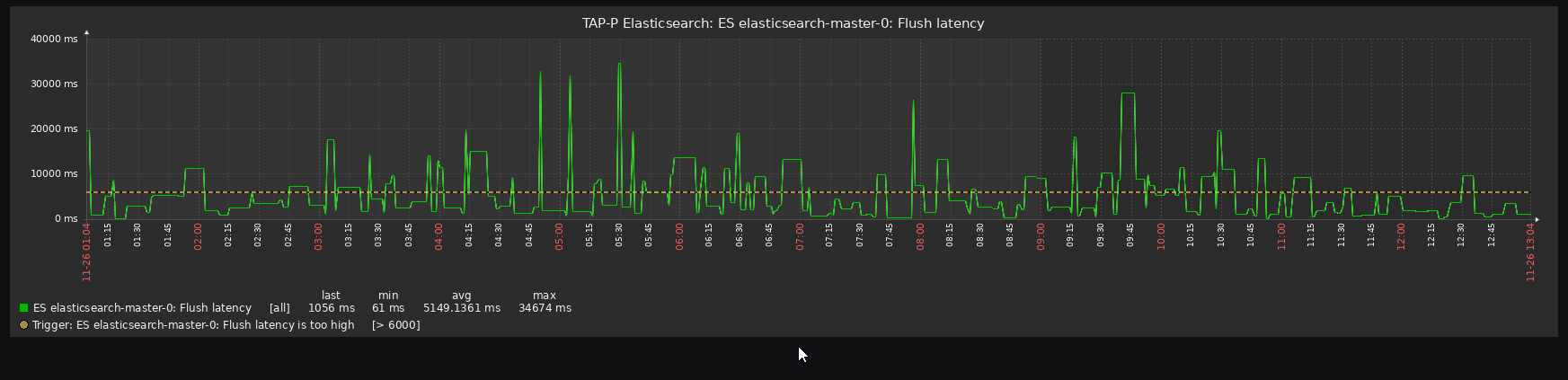
my current settings
[elasticsearch@elasticsearch-master-0 ~]$ curl -k -u "${ELASTIC\_USERNAME}:${ELASTIC\_PASSWORD}" \
> name flush.total flush.total\_time
> elasticsearch-master-0 2692 3.9h
> elasticsearch-master-1 2699 4.2h
> elasticsearch-master-2 2747 4.5h
>
> name heap.percent heap.current heap.max ram.current ram.max
> elasticsearch-master-0 67 5.4gb 8gb 11.9gb 12gb
> elasticsearch-master-1 67 5.4gb 8gb 11.9gb 12gb
> elasticsearch-master-2 46 3.7gb 8gb 11.9gb 12gb
>
> name segments.count segments.memory merges.current
> elasticsearch-master-0 624 28.9mb 2
> elasticsearch-master-1 547 24.5mb 1
> elasticsearch-master-2 579 25.6mb 1
[elasticsearch@elasticsearch-master-0 ~]$ curl -k -u "${ELASTIC\_USERNAME}:${ELASTIC\_PASSWORD}" \
> "settings?include\_defaults=true&pretty" | \
> grep -A 5 "translog"
> % Total % Received % Xferd Average Speed Time Time Time Current
> Dload Upload Total Spent Left Speed
> 0 0 0 0 0 0 0 0 - ~~::~~ - - ~~::~~ - - ~~::~~ - 0 "translog" : {
> "generation\_threshold\_size" : "64mb",
> "flush\_threshold\_size" : "512mb",
> "sync\_interval" : "5s",
> "retention" : {
> "size" : "512MB",
> –
image: \*\*elasticsearch:7.10.1
PVC\*\* Size
4096 GiB
Storage type
Standard SSD LRS
```
resources:
limits:
cpu: '2'
memory: 12Gi
requests:
cpu: 100m
memory: 4Gi
```
Thanks for help
---
### Author:  [@Christian\_Dahlqvist](https://discuss.elastic.co/u/Christian_Dahlqvist)
#### Post date: [November 26, 2025, 12:44pm UTC](https://discuss.elastic.co/t/elastic-flush-fetch-latency-too-high/383681/2 "2025-11-26T12:44:49Z")
> [@richard2](#):
>
> image: \*\*elasticsearch:7.10.1
Note that this version is very old and has been EOL a very long time. I would recommend that you upgrade, ideally to the latest version.
> [@richard2](#):
>
> from zabbix monitoring im getting a lot of notifications fetch/flush latency is too high.
> [@richard2](#):
>
> Standard SSD LRS
It sounds like your storage may be too slow for your use case. I would recommend switching to faster storage and see if that resolves the issue.
> [@richard2](#):
>
> Would changing durability to async fix the issue? "index.translog.durability": "async"
It may have an impact but I do not use this setting as it reduces resiliency and does not solve the core problem, which potentially is slow storage.
---
### Author:  [@richard2](https://discuss.elastic.co/u/richard2)
#### Post date: [November 26, 2025, 1:32pm UTC](https://discuss.elastic.co/t/elastic-flush-fetch-latency-too-high/383681/3 "2025-11-26T13:32:49Z")
Hi,
Thanks for reply
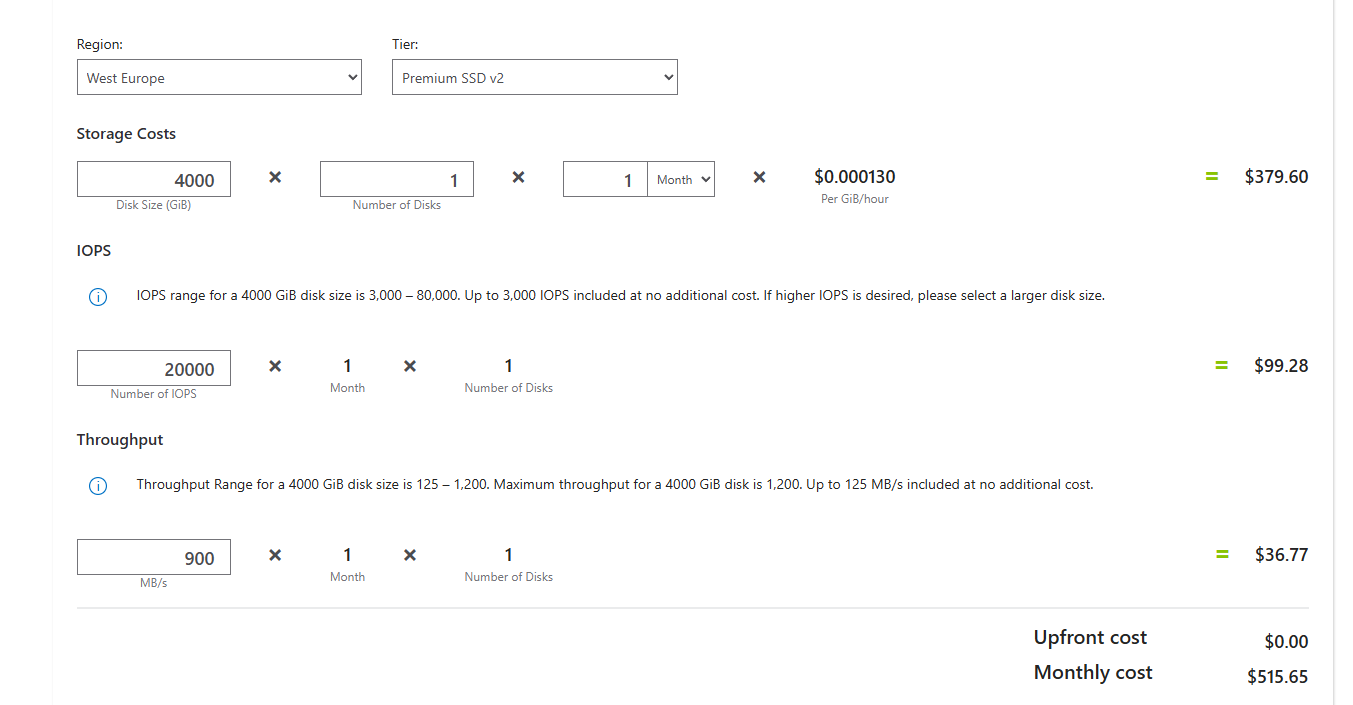
Standard SSD have Max throughput 750 MB/s IOP 6,000
Would Premiumv2 with 20k iops be enough?
---
### Author:  [@Christian\_Dahlqvist](https://discuss.elastic.co/u/Christian_Dahlqvist)
#### Post date: [November 26, 2025, 1:37pm UTC](https://discuss.elastic.co/t/elastic-flush-fetch-latency-too-high/383681/4 "2025-11-26T13:37:34Z")
Do you have monitoring of IOPS and disk I/O inplace? Id so, do you see any correlation with the times you are having issues?
---
### Author:  [@richard2](https://discuss.elastic.co/u/richard2)
#### Post date: [November 26, 2025, 3:06pm UTC](https://discuss.elastic.co/t/elastic-flush-fetch-latency-too-high/383681/5 "2025-11-26T15:06:11Z")
From azure monitoring
Last 4 h disk read operations avg 82.95s max 520/s

---
### Author:  [@Christian\_Dahlqvist](https://discuss.elastic.co/u/Christian_Dahlqvist)
#### Post date: [November 26, 2025, 6:26pm UTC](https://discuss.elastic.co/t/elastic-flush-fetch-latency-too-high/383681/6 "2025-11-26T18:26:26Z")
I do not use Azure a lot but [it seems IOPS varies by disk size](https://learn.microsoft.com/en-us/azure/virtual-machines/disks-types#standard-ssd-size). What is the size of the disk you are using?
---
### Author:  [@RainTown](https://discuss.elastic.co/u/RainTown)
#### Post date: [November 26, 2025, 7:21pm UTC](https://discuss.elastic.co/t/elastic-flush-fetch-latency-too-high/383681/7 "2025-11-26T19:21:59Z")
> [@Christian\_Dahlqvist](#):
>
> [it seems IOPS varies by disk size](https://learn.microsoft.com/en-us/azure/virtual-machines/disks-types#standard-ssd-size)
Also no real clue on Azure, but the little asterisk on the 6000 IOPS line says:
\* Only applies to disks with performance plus enabled.
Otherwise it’s 500 IOPS per disk (base) for all disk sizes according to that chart. With also pretty limited throughput.
---
### Author:  [@richard2](https://discuss.elastic.co/u/richard2)
#### Post date: [November 27, 2025, 7:53am UTC](https://discuss.elastic.co/t/elastic-flush-fetch-latency-too-high/383681/8 "2025-11-27T07:53:18Z")
That makes sense, I was thinking the limit is 6000 but in the graph it was max 500.
im using size **E50** max iops is then 500.
Looks like the performance plus mode can be enabled free of charge IOPS would be 6000 throughput 600 mb/s
I will test it if it didnt help then upgrade to premium v2
Thanks
---
### Author:  [@RainTown](https://discuss.elastic.co/u/RainTown)
#### Post date: [November 27, 2025, 8:57am UTC](https://discuss.elastic.co/t/elastic-flush-fetch-latency-too-high/383681/9 "2025-11-27T08:57:14Z")
> [@richard2](#):
>
> Looks like the performance plus mode can be enabled free of charge IOPS would be 6000 throughput 600 mb/s
Free, but with some caveats, you cannot just toggle it on for an existing disk.